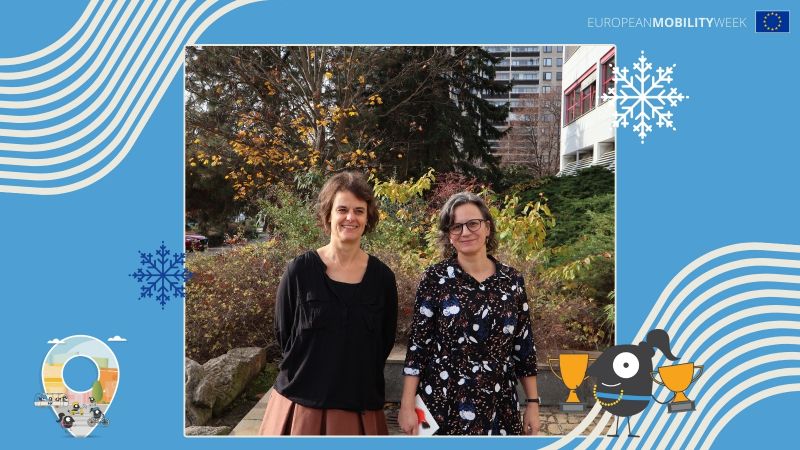
During the recent National Coordinator’s meeting in Prague, EUROPEANMOBILITYWEEK had the chance to sit down with Kateřina Machová Ondřejová and Blanka Klimešová from the organisation Pěšky městem. The initiative was recognised with the 2024 MOBILITYACTION Award for its "Walk to School" challenge, encouraging active mobility for children across the Czech Republic on their trips to school.
In this interview, they share insights into how the challenge works, the impact it has had on local communities, and the strategies they use to promote safe, enjoyable, and sustainable mobility for children.
Congratulations on winning the MOBILITY ACTION Award! Could you briefly introduce Pěšky městem and explain what inspired the initiative?
Blanka: Our organisation is dedicated to supporting pedestrians and giving a voice to groups that often remain unheard - particularly children and seniors. We want cities where everyone can move safely and independently. Much of our work focuses on strengthening communities and helping improve communication between residents, schools and public authorities.
A large part of our mission centres on children, because we see how little time they spend outdoors today. We want them to feel confident in the city, able to move around without fear, and included in public space. For that reason, we partner closely with schools, helping them improve safety around their buildings and making the surrounding areas calmer, more pleasant and more liveable. Sometimes this involves infrastructure proposals; other times it’s about education and encouraging active mobility.
Kateřina: One of our main initiatives is the "Walk to School" challenge and we are especially proud to have received this recognition from EUROPEANMOBILITYWEEK for our efforts. We launched it in 2017 as a motivational effort to encourage active journeys to school. It has grown enormously - more than 500 schools now participate - and their creativity and enthusiasm really elevate the project.
Our work engages children, their parents, teachers and the wider community. Walking has so many benefits: physical health, mental health, environmental impact and stronger social connections. The challenge helps people, particularly parents and teachers, see those benefits in practice. It also includes a creative and educational dimension: children prepare small projects on mobility and public space and even communicate with authorities and police, learning how to engage with decision-makers and advocate for change.
What has been the impact of your initiatives on local communities? Have you noticed changes in behaviour or attitudes toward walking and sustainable travel?
Blanka: One of the biggest impacts is simply bringing these issues into public conversation. The safety of children and the value of active mobility are being discussed more openly. We’ve seen a shift away from the idea that children alone are responsible for staying safe through wearing visibility vests or taking other precautions. Instead, people are starting to acknowledge that driver behaviour and street design play a central role.
Kateřina: Many parents were used to a very car-oriented routine around schools. When we highlight the needs of children - how they move and what helps them feel secure - it changes perspectives. They begin to see that walking to school is not as risky or complicated as they once assumed. In fact, they often realise children enjoy it. We’ve heard from many parents who tried walking during the challenge and continued because the experience was better than they expected. These may be small steps, but they lead to long-term change. Around many participating schools, we’ve already seen slight shifts in how people travel.
Many challenge participants work with limited resources. What advice would you offer to other cities or organisations hoping to start a similar initiative?
Blanka: The most important thing is to build on the needs that already exist. Schools have been observing these problems for years. They see on a daily basis how children are affected by traffic and unsafe surroundings. The desire for improvement is already there; what we do is amplify their voice and provide structure. Being part of a national movement also helps schools feel they are not alone in their efforts.
Kateřina: We try to equip schools with practical tools. We provide educational materials for parents and teachers, worksheets and guidance on activities that can be done on different budgets. But honestly, what makes the challenge successful is the energy and enthusiasm of the schools themselves. When they embrace the project creatively, it becomes a true community movement.
Engaging the local community in mobility initiatives can be challenging. How do you involve people and encourage them to participate?
Blanka: Changing mobility habits is extremely difficult. Car use is a strong habit - almost like a form of addiction. To shift behaviour, people need positive emotional experiences. We encourage schools to organise pleasant activities such as breakfast events, music performances, or community gatherings in front of the school. When people associate walking or cycling with joy, it becomes easier for them to adopt those habits and accept the work we are doing.
Kateřina: One principle we follow is staying positive. We don’t focus on frightening statistics or accident rates. Instead, we highlight the positive experiences that active mobility brings. This year, our motto was "Schools as the heart of the neighbourhood", emphasising the importance of schools as community hubs. We also use a “pedestrian diary” for children, where they can tick off animals, people or objects they notice on their way to school. It encourages mindfulness, observation skills and a stronger connection with their surroundings and nature.
What strategies have helped you demonstrate the potential of more people-friendly streets?
Kateřina: Tactical urbanism, such as our "asphalt art" outside schools, has been a powerful tool for us, with these temporary interventions highlighting what is possible. Removing a few parking spaces and adding benches or greenery can completely change how people experience a street. It’s visual, immediate and effective in sparking discussions. We want streets to be seen as not just places of movement, but also as places for meeting, playing, and living.
Blanka: Many schools have gone even further than we anticipated. They’ve installed bike racks, tested school streets, or tried new forms of traffic calming. Our main challenge now is convincing public authorities to make these changes permanent. That requires a deeper shift in mindset - seeing school surroundings as protected zones where children’s safety and quality of life come first. Encouraging that broader view is our biggest long-term challenge, but we’re fully committed to it.
Looking ahead, what are your priorities for the future of Pěšky městem?
Kateřina: Our focus is clear: safer streets and more liveable neighbourhoods. We want fewer cars around schools and more space for people. Ultimately, our dream is simple but profound - to restore children’s independence in public space. We want children to be able to walk, cycle and move around their neighbourhoods freely, confidently and without fear. If we can help cities take steady steps toward that future, then we will have succeeded.
To find out more about Pěšky městem visit their website here or follow them on their Facebook or Instagram page.