EUROPEANMOBILITYWEEK News

News Search Result ( 16 - 20 from 194 )

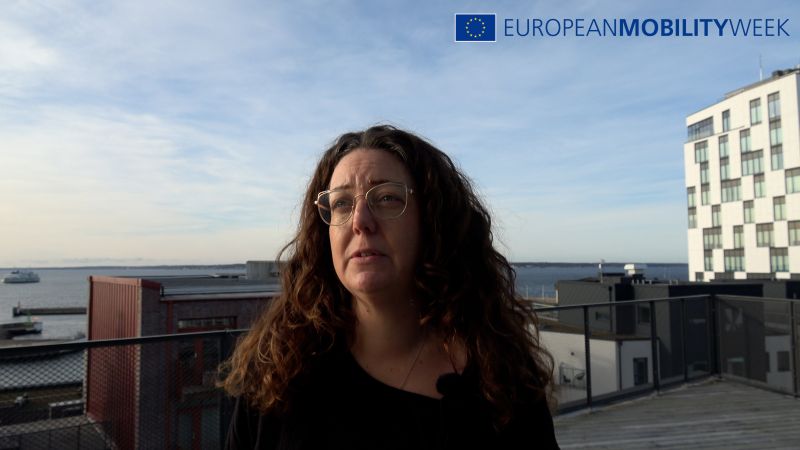
Interview with Emma Kangas on the city of Helsingborg's 2023 MOBILITYACTION Award winning partnership

19 December 2024

The city of Helsingborg, Sweden, has been making remarkable strides in sustainable urban mobility, from significant investments in cycling infrastructure to innovative behavioural change initiatives. Helsingborg developed a pilot project in collaboration with Nudgd in autumn 2023, to help increase the modal share of cycling, which went on to win the 2023 MOBILITYACTION Award. During a visit to Helsingborg, we had the opportunity to speak with Emma Kangas, a representative from the city about their efforts to foster a cycling culture, the groundbreaking pilot project, and their vision for a sustainable future.

In this interview, Emma shares insights on the infrastructure upgrades, the behavioural shifts observed among residents, and their ongoing collaboration with Nudgd to foster a more active and sustainable mobility culture.


What infrastructure changes have been made in the city of Helsingborg during the last years regarding active sustainable mobility?

Helsingborg has invested a lot in infrastructure during the last ten years. In the last couple of years, we've spent almost 10 million EUR yearly on cycling infrastructure, so it's been a large focus for us for a long time now. I would say that in the last couple of years we have also created a lot of pedestrian crossings, making it even safer for cyclists and making it mandatory for cars to stop.


Could you tell us about the work carried out by Helsingborg lately and if you have noticed any behavioural change?

I would say that Helsingborg for quite some time has had a strong car culture. The people in Helsingborg do like their cars and it's quite easy to travel by car in Helsingborg. But we also see all the benefits with cycling and walking and taking the bus. I want to say that taking the bus is also a form of active travel, because you have to walk to the bus and it still makes you move your body just a little bit. In the last five years we've seen an increase from an 11% share of trips made by bike to 16% now, so it is increasing. We're really happy about that. We’ve also invested more and more in increasing the culture in the city when it comes to cycling, such as doing bike parades and we're doing a lot of events with children. It's something we're aiming at from many different directions, both infrastructure and mobility management, children and workplaces in Helsingborg. So, it is a major work that we're doing.


Could you tell us more about the area of “Oceanhamnen” (Helsingborg’s Innovation District)?

Yes, so this is “Oceanhamnen”. It's very new. It's only been here for the last two years, since when we had the big city fair for innovation. Its major focus is on environmental sustainability, when it comes to plumbing and mobility for example and the buildings are all green labelled. We're really proud of this new area, with the closeness to the sea. And it's a very attractive place to live in and to work in for the people of Helsingborg.


What do you think made your partnership with Nudgd such a success for the MOBILITYACTION award winning pilot project?

We started our partnership with Nudgd during last fall, when they gave us this suggestion to work with children in a new inventive way. We have been working with children for a long time in Helsingborg, but adapted their suggestion to work more with a digital approach, a web platform and using nudges, competition, and gamification for the children. So, for us, that was very exciting, and we wanted to give them the opportunity to try it, as a pilot here in Helsingborg. And we did during last fall and that's where Nudgd won the award together with us. We are still in close contact with them because we are really interested in all their knowledge in behavioural change. It has been a real learning experience for both of us, I think.


Why was the focus of the pilot placed particularly on school routes and journeys to school?

I would say that, in Helsingborg, as in most of Sweden and most of Europe, I guess, we see a decrease in how much children are moving and being physically active and this is really alarming for us. We see that if you walk or take your bike to school in the morning, that that affects the whole day. You get better grades, you're happier and you get this habit of moving more. It changes how you travel during the whole day, and during the weekend even.

And we also see that if the parent goes by bike with the kid to school, the parent then will take the bike to the office. So, it has this long-term effect as well, affecting the grown-ups too. We think it's really important to start with that first puzzle. How do they leave their home in the morning? And then it will have good effects for the rest of the day. Ultimately, working with children and their safety and their freedom to move is really important for us.


What do you think are the next steps for creating a sustainable cycling culture in the city?

I've been working a lot with something we call test cyclists, where citizens of Helsingborg are invited to just try to commute by bike for six weeks. And we realised that if they try it, they all discovered that it is the best way to travel. It's nicer, it's cheaper and it's faster. It's so much more convenient in many ways. We have tried many different communication campaigns and all kinds of projects. But, when we try to convince people, not much happens. However, if we ask them to try by themselves, they discover that it is the best way to move and that it's just easier for everybody.

We don't want to force anybody either, so if they discover it by themselves, I would say that’s the best way to go. If they discover it themselves, they will also share it with their family and their coworkers, and it will spread. That is my main focus and what I'm trying to work with all the time, getting people excited about biking and to share that excitement with others so that it spreads around.


A full video version of the interview can be viewed here on the EUROPEANMOBILITYWEEK Youtube channel.

More information about the MOBILITYACTION Award, as well as the other finalists of 2023 and previous winners can be found on the MOBILITYACTION Award page. This year's finalists and winners will be announced in March 2025.
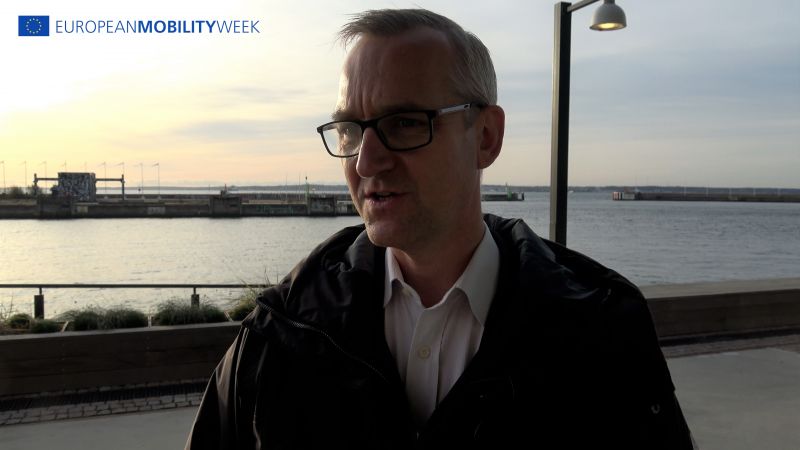
Interview with Ola Rynge: Insights from 2023 MOBILITYACTION Award-Winning Nudgd

5 December 2024

The 69th EUROPEANMOBILITYWEEK National Coordinators meeting recently took place in Helsingborg, Sweden. This location was chosen due to it being home to the 2023 MOBILITYACTION Award winning pilot project, carried out by the sustainable behavioural science specialists Nudgd, in partnership with city authorities. We were fortunate enough to find some time to speak with Ola Rynge, CTO and Co-Founder of Nudgd during the visit in Helsingborg.

In this interview, Ola reflects on the MOBILITYACTION award, the strategies that propelled Nudgd to success in this pilot project, and the most effective ways they have found so far in helping progress towards sustainable urban mobility transformation.


Could you describe in your own words the work that Nudgd does?

“We work with behavioural science and the method of nudging. We have our digital nudging platform. It’s one of a kind, and we apply that to cities for nudging citizens towards more sustainable behaviours, such as taking the bike instead of the car or using less fresh water, or using energy at the right time of the day.

By using it in a digital form, we can personalise it to each individual, which makes it more efficient. 43% of our users say that they have adopted a more sustainable behaviour, based on our platform.”


Could you tell us more about the Mobility Action Award winning pilot project carried out by Nudgd?

“So this was an EIT (European Institute of Innovation and Technology) Urban Mobility RAPTOR project that we did last year, in 2023. It was a short time, only five months that we were allowed to do this implementation, and the aim was to get more people in Helsingborg to bike. That was the overall scope and our proposal to the city was to do that together with the schools. So we did a project with school mobility where we, through the school platform, sent out an invitation to our platform, to the parents and also staff at about half of the schools, from 0 to 9 grades, here in Helsingborg. It was about almost 9000 individual parents that got this message and also almost 1000 staff.  In the end almost 2500 people entered the platform and hence got the messaging and were nudged toward a more standard behaviour.

Depending on the motivations of the parents, we changed the messaging. In the end four out of ten parents said that they also adopted more sustainable behaviours due to that. We were really happy that we got recognised by the European Mobility Week Action Award. We got a lot of recognition from that, so we are really happy.”


Your project was largely based on active mobility and participation. What do you think made this approach so successful?

“I think that to get good results when you're talking about a modal shift, we need to consider both having some infrastructure change and we need to do some regulation change, like traffic calming etc. All these measures are relevant. But, you will also need to work with behaviour change, and that is something that is usually overlooked. It's quite a cost effective and good method to implement. Using interactive and digital tools, as I mentioned earlier, we are able to personalise it to each individual's motivations. By doing that we can reach a lot better relevance to each end-user and hence also be more prone to, or have more possibility, to make them change their behaviour.”


What do you think made Nudgd’s partnership with the City of Helsingborg so successful?

“It's really important to be engaged and to have the right expectations. In this case, the expectation was actually a lot lower than the results. We could have had a little bit more courage in that. In the case of Helsingborg, where we worked with the environmental department, they were the project leader. But we needed to integrate the school department and also the overall city department itself. Getting those to work together in Helsingborg was really smooth. And also, given that we had a really short time to reach the end user, we needed to get the school principals on board and the school department on board. And one of the reasons there is that if you want to communicate with parents, for example, you can’t send something from the school every day because then they would stop reading. So it has to be a good level of frequency. And we were happy that so many schools could get us into that.

What we would like to do in the future, is to look into how we can work more with the actual kids. Because kids have a lot of influence on their parents as well. So, if we can work with both these groups, I think we could have a lot of opportunities to make more school children be more active in their mobility.”


What are the implementation challenges you experienced in relation to the pilot project?

“It's a good question. We are working with quite a lot of pilots, especially internationally. A success factor, if you want a pilot to actually become implemented and be creating impact over time, is for both the city and also the startup, and also third-party financiers if they are involved, to have a plan from the beginning. And to have the mindset that this is not a project that ends by the product end, but that it ‘ends’ with a continuous implementation.

If you have that mindset and start with that even before the award of the pilot project, and to be having these discussions already, I think you have a lot more opportunities to succeed and have an ongoing pilot afterwards. Especially when it comes to municipalities or cities where we have to work with procurement. So, you could make that procurement even in the early stage of the pilot. And then giving relevant KPIs from the beginning. So, if we reach this and this KPI, then we already have a procurement in place, and we will also continue with the project. I think that would be our ideal way of doing it.”

A full video version of the interview can be viewed here on the EUROPEANMOBILITYWEEK Youtube channel.

More information about the MOBILITYACTION Award, as well as the other finalists of 2023 and previous winners can be found on the MOBILITYACTION Award page. This year's finalists and winners will be announced in March 2025.
 

The City of Parma commits to EU Cycling Declaration implementation

8 October 2024

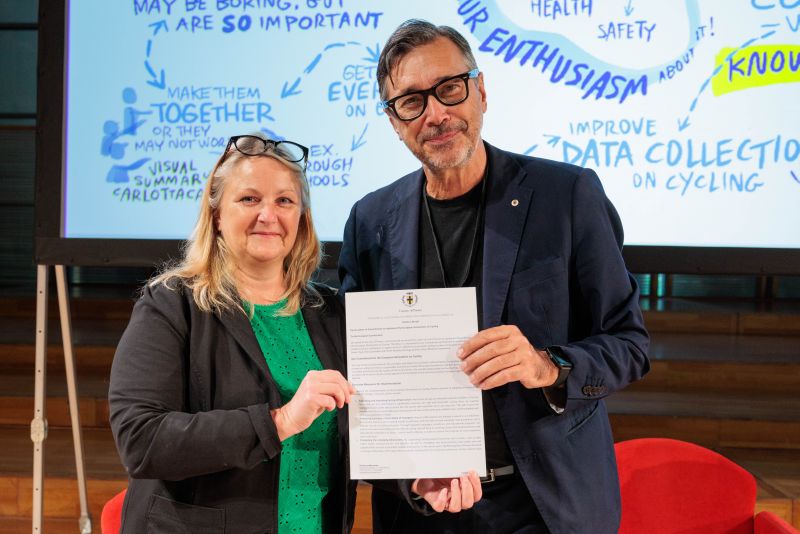
Gianluca Borghi, Parma Deputy Mayor for Environmental Sustainability, Energy and Mobility, presented a Letter of Commitment to implement the European Declaration on Cycling to the European Commission during the closing plenary of the CIVITAS Forum on 3 October 2024. The document outlines Parma's plans to set the wheels in motion for other cities to follow suit in implementing the European Declaration on Cycling.

“As cities across Europe work to achieve climate neutrality and improve quality of life, it is imperative that cycling remains a priority in EU sustainable mobility strategies. The CIVITAS Initiative has a vital role in ensuring that cities are equipped with the resources, knowledge, and network to implement the European Declaration on Cycling successfully. I call on the CIVITAS Initiative to keep promoting the principles of the declaration and to continue supporting cities in creating safe, connected, and inclusive cycling networks, enabling the full potential of cycling to be realized for healthier and more vibrant communities.” says Gianluca Borghi, Parma Deputy Mayor for Environmental Sustainability, Energy and Mobility.

The Parma Letter of Commitment reflects key messages from the CIVITAS Politicians Exchange Forum (PEF) held on 1 October ahead of the CIVITAS Forum. Over 15 elected representatives from European cities met with Eddy Liégeois, Acting Director for Investment, Innovative & Sustainable Transport at DG MOVE, and cycling sector representatives. They discussed challenges and solutions for implementing the European Declaration on Cycling, highlighting the need for political leadership, strategic planning, investment in cycling infrastructure, education, and partnerships. The session also stressed multimodal integration and e-bike adoption to enhance accessibility and reduce car dependency.

“The City of Parma has made great efforts, together with CIVITAS, to showcase the best practices in sustainable urban mobility and innovation. We appreciate their commitment to take concrete actions in implementing the European Declaration on Cycling” highlights Eddy Liégeois, Acting Director for Investment, Innovative & Sustainable Transport, Directorate-General for Mobility and Transport, European Commission.

CIVITAS Forum inspires a mobility renaissance

7 October 2024

"Designing urban spaces that prioritise people and integrate innovative mobility solutions are crucial for a just transition. When executed thoughtfully, these efforts will lead to happier, healthier, and more resilient communities”.

These were just some of the reflections of Thomas Haddock, Coordinator of NetZeroCities, while cycling over 300km to Parma for  the CIVITAS Forum last week! Upon his arrival Thomas and Andreas Piller, CIVITAS coordinator, signed an MoU, which outlines how the CIVITAS Initiative and NetZeroCities will work together to strengthen support for cities to develop sustainable mobilitysystems as a cornerstone of their transition to climate neutrality.

"Together we’re putting the wheels of climate neutrality in motion” emphasises Andreas, highlighting the essential role that active mobility plays in achieving climate neutrality.

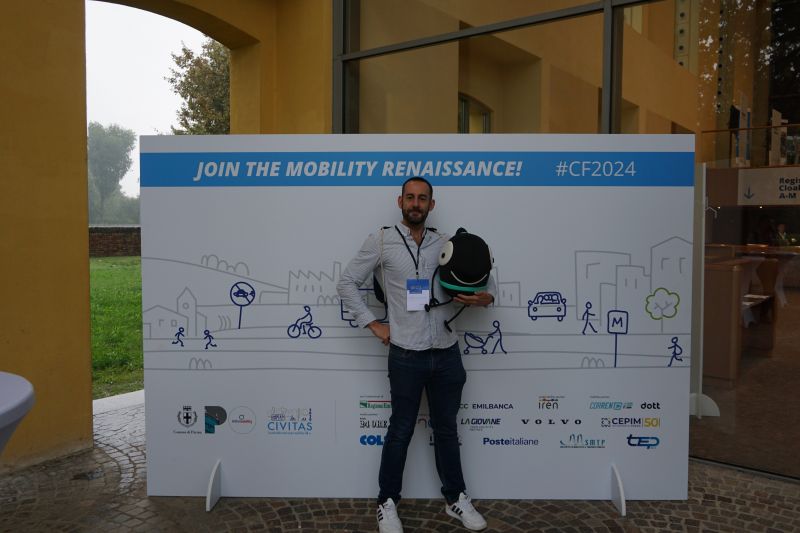
The CIVITAS Forum, which took place between 1-3 October, is the flagship conference of the CIVITAS Initiative. EUROPEANMOBILITYWEEK was also represented at the event in the exhibition area by Coordinator Juan Caballero. There he joined forces with 400+ sustainable mobility policymakers, practitioners, planners, academics and more to share knowledge and collaborate towards three key streams:

  • Climate-neutral and resilient mobility
  • Smart, connected and efficient mobility
  • Inclusive and safe mobility for all

Day 1 began with politicians from all over Europe coming together for the CIVITAS Politicians Exchange Forum. The focus was on implementing the EU cycling declaration at all levels. Some crucial elements discussed covered political leadership, ensuring a clear vision and financial resources to unleash the full potential of cycling. This lead to a key highlight of the event in the shape of the City of Parma commiting to the EU Cycling Declaration implementation. The document, which Gianluca Borghi (Parma Deputy Mayor for Environmental Sustainability, Energy and Mobility) signed in the closing ceremony on Day 3, outlines Parma's plans to set the wheels in motion for other cities to follow suit in implementing the European Declaration on Cycling.

Key themes highlighted by speakers and participants during the event covered financing, policy and infrastructure needs, as well as inclusion and collaboration. A delegation of youth representatives encouraged more youth involvement and diversity to better represent the needs of all in sustainable urban mobility planning. Gunta Anca, Vice president of the European Disability Forum, also reinforced the key message of the conference, that sustainable urban mobility is not only about green and active transport, but also about inclusivity and ensuring that no-one is left behind in the mobility transition.

View the photos from the CIVITAS Forum 2024.

Eight Ukrainian cities and towns participate in EUROPEAN MOBILITY WEEK

30 September 2024

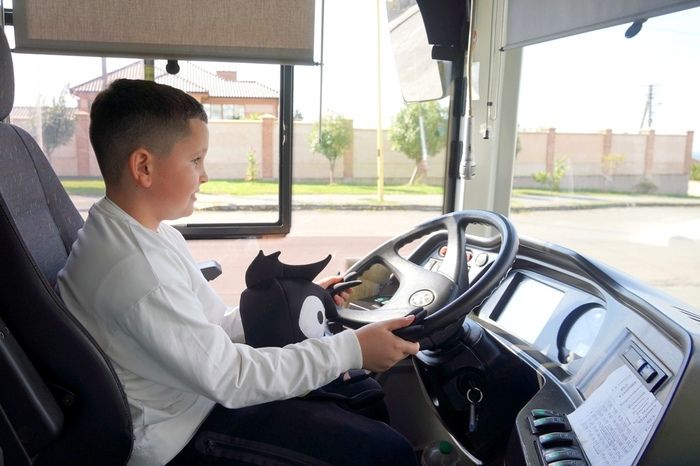
Despite Russia’s full-scale invasion of Ukraine, eight cities and towns across the Ukraine participated in EUROPEANMOBILITYWEEK in 2024. During this year's campaign week, awareness-raising activities in the Ukraine ranged from pedestrianising streets and roller skating competitions, to a school bus excursion to the local municipal transport company to motivate pupils to use more public transport.

Active EUROPEANMOBILITYWEEK cities included Lviv, which hosted its 2nd Urban Mobility Forum, Chernivtsi, Irshava, Krasnokutsk, Slobozhanske, Uzhhorod, and the front-line cities of Chernihiv and Poltava, where only a few weeks prior, a deadly attack had led to over 50 fatalities and hundreds being injured.

To learn more about the EUROPEANMOBILITYWEEK activities in Ukraine, click here.